

Steady Leadership for Gibsons’ Next Chapter

Gibsons is changing fast — property taxes are climbing, and 1,211 new homes are already in the development pipeline. Des Delaney is a construction project manager who’s called Gibsons home since 1987. He’s running for Mayor with one job in mind: help Council keep spending focused on core services, keep tax increases in line with inflation, and make sure the town can actually support the growth it’s approving.

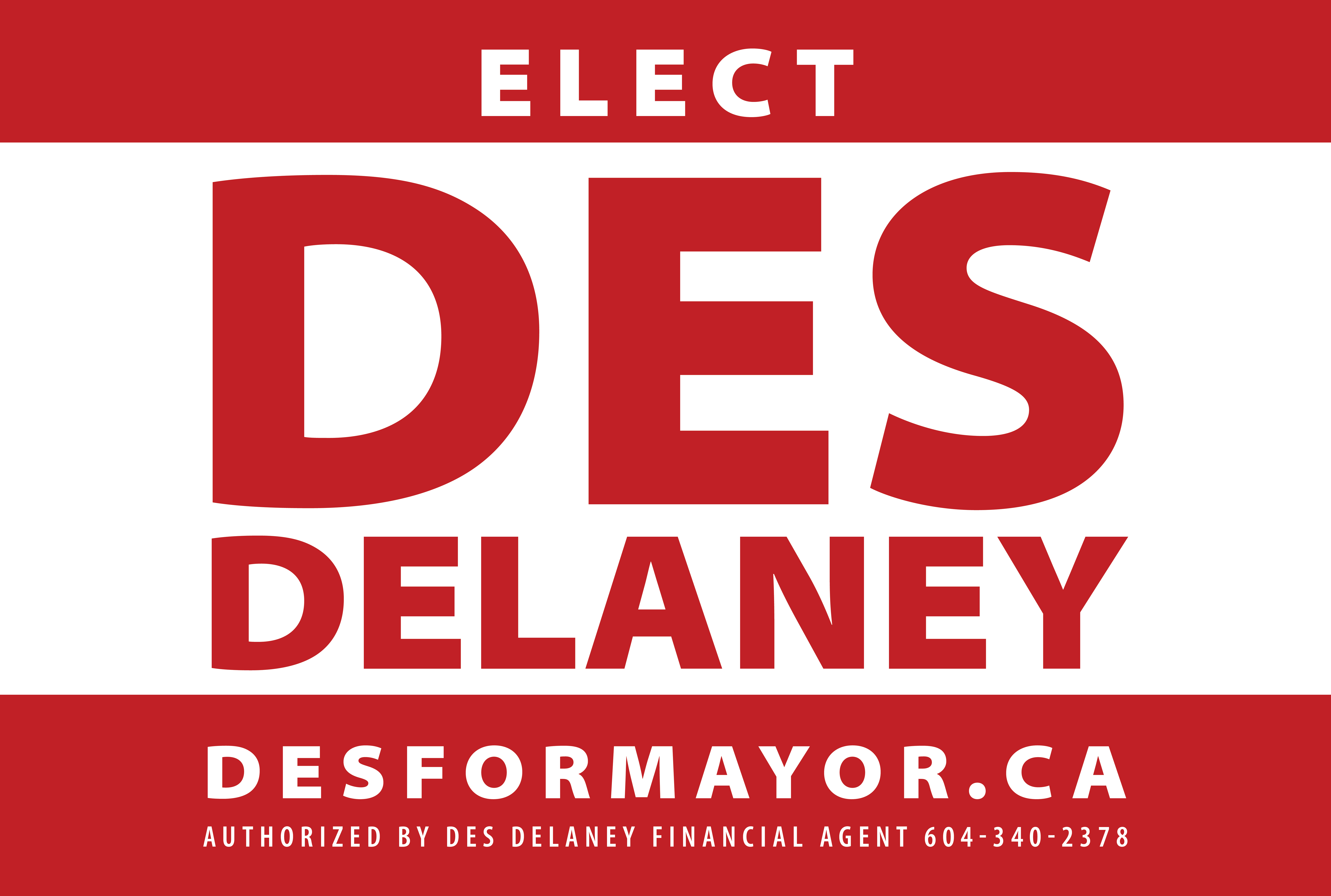
Elect Des Delaney campaign lawn sign, desformayor.ca
Des Delaney, smiling outdoors with the Gibsons harbour and forest in the background

A Neighbour Who Knows How to Get Things Done

Des Delaney first came to Gibsons in 1987, drawn out by his wife’s family in Davis Bay — the Sunshine Coast has been “our backyard” ever since, and their son grew up summering on the beach here. For the past 10 years, Des has called Gibsons home as a local homeowner.

By trade, Des is a construction project manager — the guy who’s spent a career being the “numbers guy”: budgeting, scheduling, and pulling together teams of consultants, tradespeople, and specialists to get complex projects built right. He’s managed crane operations on major Gibsons builds, run companies across North America and overseas, and knows how to read a financial statement without a communications team standing between him and the facts.

“Five good people are always going to be better than one good person.”

That’s the philosophy Des is bringing to the Mayor’s office: not a one-man show, but a facilitator who helps Council do its best work.

  • Connected to Gibsons since 1987; local homeowner for 10 years
  • Career construction project manager — budgeting, scheduling, and team leadership
  • Experience assembling and running teams of consultants and specialists on complex builds
  • Running for Mayor, not against Council — the sole challenger to the incumbent in a two-person race

A Practical Plan for Gibsons

Five clear priorities, grounded in the town’s own financial and planning documents.

Collaborative Leadership

Gibsons runs on a “weak mayor” system — the real power sits with Council, and the Mayor’s core job is to chair it well. Des sees that as a strength, not a limitation: he wants to be an equal voice at the table, not a boss.

  • Works as an equal vote alongside four Councillors — no single person controls the agenda
  • Facilitates balanced decisions by weighing financial, social, and environmental impact on every issue
  • Uses his business and people-management background to help guide discussion, not dictate outcomes

Fiscal Responsibility

The cost of living in Gibsons is rising, and residents felt it directly this year when their tax notices arrived. Des wants Council to have an open, numbers-based conversation about spending before asking residents for more.

  • Push staff to prepare a budget built around a 0%–3% tax increase, in line with inflation
  • Review town expenditures — including the roughly $1.7M spent annually on planning and engineering consultants — to ensure spending is actually being used
  • Make the town’s public financial documents easier for residents to actually read and follow

Core Services First

Before funding anything else, Des believes Gibsons needs to be honest about what it must have versus what’s simply nice to have.

  • Must-haves: water, sewer, garbage collection, and policing
  • Nice-to-haves get evaluated openly for their real social and environmental value — not funded by default
  • Recognizes community-run initiatives, like the volunteer-supported Gibsons Public Market, that already deliver value without new tax dollars

Infrastructure Before Expansion

Gibsons’ own Complete Community Assessment is direct: the sanitary outfall is already at capacity. Des thinks that has to be part of the conversation before the town approves more of the 1,211 housing units currently in the development permit pipeline.

  • The town’s sanitary system is already at capacity, according to its own commissioned report
  • Water isn’t the constraint — Gibsons’ aquifer licenses can support growth up to roughly 6,000 people — but sewer capacity is the real limiting factor
  • New development needs a serious, public discussion about who pays to upgrade the sanitary system, and when

Community Wisdom

Gibsons has a deep bench of retired residents with real professional experience — engineers, tradespeople, project managers, and more. Des wants to put that experience to work for the town.

  • Create advisory committees that draw on the technical and professional skills of local retirees
  • Get credible, experienced input on town issues at no added cost to taxpayers
  • Build a standing habit of asking residents directly what they want addressed, and reporting back on what was done

See the Numbers Yourself

Every figure above comes straight from the Town of Gibsons’ own public documents. Here’s exactly where to find them:

How a Small Town Budget Actually Works

Des puts it plainly: the average person isn’t going to sit down and read a 50-page financial statement. Here’s the plain-language version — where Gibsons’ money comes from, the trade-offs every small town has to balance, and how a budget actually gets built.

Where the Money Comes From

Gibsons has only three real sources of revenue: local charges, growth-related fees, and outside grants.

Local Revenue

  • Property taxes — the primary, ongoing source of town revenue
  • User fees & charges for water, sewer, and transit
  • Permit & licence fees for building, business, and zoning applications

Growth & Development Financing

  • Development Cost Charges (DCCs) — levied on developers to help pay for the infrastructure their projects require
  • Latecomer agreements — recovering costs from developers who benefit from infrastructure others already paid for
  • Parkland acquisition fees — cash or land contributed as new subdivisions are approved

Provincial & Federal Grants

  • Conditional grants tied to a specific, targeted project
  • Unconditional grants Council can direct where it’s needed most
  • UBCM programs and the Green Municipal Fund, covering things like FireSmart, emergency preparedness, and sustainability projects

Grants aren’t free money — they’re still taxpayer dollars, just collected by a different level of government. Des believes Council should chase grants for what the community actually needs, not simply because the money is on the table.

The Three Pillars Council Has to Balance

Economic

Small towns lean almost entirely on property taxes, so decisions about roads, water lines, and other core infrastructure directly affect what residents and businesses pay — and what the town can attract or keep.

Social

Budgets fund the things residents feel day to day — parks, the library, transit, accessibility — alongside a growing list of pressures, like housing and food security, that used to sit with senior governments.

Environmental

With limited cash on hand, small towns generally can’t fund big climate projects outright. Most progress comes from low-cost policy choices and using local dollars to unlock outside grants.

How the Budget Gets Decided

  1. Foundation & revenue assessment — staff project fixed costs and statutory reserves, and calculate how property taxes are split across residential, business, and other classes.
  2. Public consultation & trade-offs — Des wants staff directed to build the budget within a 0% to 3% (inflation) tax increase, then show Council exactly what has to be cut, modified, or delayed to get there.
  3. Five-year plan adoption — the operating and capital budget is finalized before the statutory deadline, setting direction for the next five years, not just the next twelve months.

News & Events

Campaign announcements, all-candidates meetings, and upcoming events will be posted here as the campaign progresses.

Check back soon — or follow along on Facebook and Instagram for the latest updates.

Tell Des What Matters to You

This campaign isn’t about one person’s promises — it’s about building a plan around what Gibsons residents actually want. Send Des your questions, priorities, and concerns. He’s collecting feedback from residents throughout the campaign and will share a plan, shaped by what he hears, before election day.

Authorized by Des Delaney, Financial Agent, 604-340-2378.